
What do Christians owe those who suffer under oppressive regimes when their nation doesn’t go to war on their behalf?
If war is not justified, it can feel as though nothing meaningful can be done.
But the choice is not between military action and indifference.
A Present Reality: War Is Not Theoretical
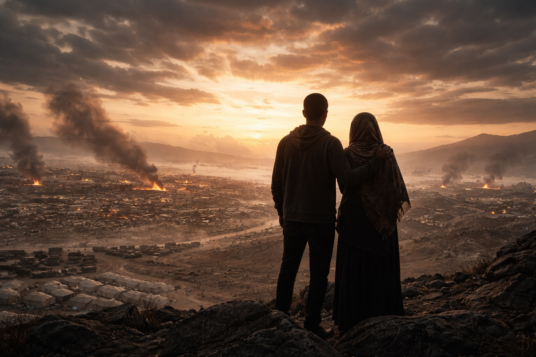
The United States is now actively engaged in war with the regime in Iran. Thousands of strikes have already been carried out, with no clear end in sight, and the conflict continues to expand across the region.
Iran has retaliated with missile and drone attacks across multiple countries, targeting energy infrastructure and threatening wider escalation.
American forces have already taken casualties.
If war is sometimes necessary, but often destructive and uncertain, what remains when it is not chosen?
This is not theory. It is the real cost of choosing war.
War Is Not the Only Form of Action
Military intervention is not the only way a nation responds to injustice.
Governments use other means—economic pressure, sanctions, diplomatic isolation, and support for allies—to confront regimes without direct invasion.
These measures are often slower and less visible. They rarely resolve conflicts on their own. But they exist because war is not the only tool available.
The question is not simply whether to act, but how.
The Church Is Not Powerless
Though the church does not command armies, it is not removed from the realities of oppression.
The church’s role is different, but not irrelevant. It operates through people, relationships, resources, and truth — often in places where governments have limited reach or credibility.
In many parts of the world, the church continues under pressure rather than above it. In North Korea, believers gather quietly under the threat of severe punishment. In Iran, Christian communities persist despite surveillance and restriction.
It takes practical form:
- Supporting persecuted believers and underground churches
- Providing financial and material aid in unstable regions
- Assisting refugees displaced by violence and repression
- Using public platforms to expose injustice and keep attention on it
- Building relationships across borders that strengthen endurance
These actions don’t replace political decisions, but they often outlast them.
Removing a Regime Is Not the Same as Establishing Justice
One reason caution exists around military intervention is not only the cost of war, but the uncertainty of what follows it.
History shows that removing a regime does not guarantee stability or justice. The aftermath of the Iraq War illustrates how quickly a power vacuum can lead to prolonged instability, internal conflict, and new forms of violence. The long involvement in Afghanistan revealed similar limits — external force can remove threats, but it cannot easily build a durable political and social order.
These outcomes do not mean intervention is always wrong. They do show that it is never simple.
“Liberation” is often clearer at the moment of removal than it is in the years that follow. Order requires more than the absence of a dictator. It requires institutions, legitimacy, and internal coherence — things that cannot be imposed quickly from outside.
This is why the question is not only whether war can stop evil, but whether it can leave something better in its place.
A Hard but Necessary Position
Christians are not permitted to ignore suffering because it is distant. But neither are they required to assume that military intervention is the primary or best response in every case.
For Christians, this responsibility takes practical form:
- Remaining informed about injustice beyond their borders
- Speaking truthfully, even when it is inconvenient
- Supporting those who suffer through material and relational means
- Using available avenues to apply pressure where appropriate
- Accepting that some outcomes will remain uncertain
This work is slower than military action. Less visible. Often less satisfying.
But it is more honest about what can actually be achieved.
Not every evil can be confronted with military force.
Not every injustice can be corrected from the outside.
Not every situation permits a clean resolution.
And yet responsibility remains.
Not to control the world.
But to act faithfully within it.
Leave a Reply