
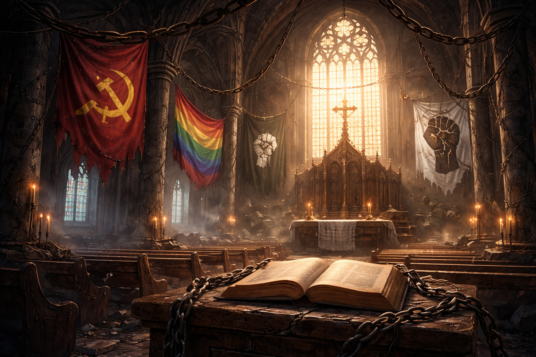
When justice is left undefined in the church, it does not remain empty.
It gets filled.
And what fills it is rarely Scripture.
If church leaders do not define justice carefully and repeatedly from the Word of God, congregants will define it for themselves. And they will not define it from Deuteronomy, Leviticus, Proverbs, or Romans. They will define it from the air they breathe — academia, corporate trainings, social media discourse, political activism — perhaps blended with a thin layer of Christian vocabulary.
Undefined justice is dangerous because it becomes captive.
1. The Chameleon Effect: Justice Takes the Shape of Culture
Without scriptural moorings, justice becomes a placeholder term — filled with personal preferences, political assumptions, or prevailing social theories.
In our cultural moment, much of the justice framework circulating in Western institutions has roots in Marxist analysis of power, class, and structural conflict. Most Christians who absorb its assumptions have no idea where those ideas originated. They simply inherit them as moral common sense.
From there, justice becomes primarily about:
- group identity,
- power redistribution,
- systemic analysis,
- equity of outcomes.
But Scripture grounds justice elsewhere.
“You shall do no injustice in court. You shall not be partial to the poor or defer to the great, but in righteousness shall you judge your neighbor” (Leviticus 19:15).
Biblical justice is impartial. It does not privilege the powerful. It also does not privilege the weak. It judges according to truth.
When justice changes definition every election cycle or social media trend, the church stops being a moral compass and becomes a mirror of secular society.
2. Relational Polarization Within the Church
When justice is undefined, two believers can use the same word while meaning entirely different things.
One member may think of justice primarily in retributive terms — punishing wrongdoing. Another may think of justice primarily in distributive terms — reallocating resources to correct disparities.
Without a shared biblical framework — the Hebrew concepts of mishpat (rectifying justice) and tzadeqah (righteousness in right relationships) — confusion becomes inevitable.
The result?
Tension in small groups.
Frustration from the pulpit.
Accusations in leadership meetings.
Eventually, division.
When “justice” means different things to different factions within the same church, the word itself becomes combustible.
3. Outcomes Replace Impartiality
Biblical justice demands fairness, not engineered equality of result.
Scripture repeatedly insists on impartiality:
“You shall not pervert justice” (Deuteronomy 16:19).
“A false balance is an abomination to the Lord” (Proverbs 11:1).
Undefined justice, however, often assumes that unequal outcomes automatically signal injustice. Group-level imbalance becomes assumed oppression.
But Scripture does not define justice by numerical symmetry. It defines justice by faithfulness to truth and law.
Not all inequality is injustice (Matthew 20:1–16).
Not all suffering is oppression (John 9:1–3).
When outcomes replace impartiality as the standard, justice shifts from moral evaluation of deeds to social engineering of results.
That’s not biblical justice.
4. Identities Replace Deeds
Undefined justice often shifts moral weight from actions to group membership.
Guilt or innocence becomes attached to identity categories rather than personal conduct. Entire classes of people are treated as default oppressors or default victims.
Yet Scripture consistently grounds moral responsibility in personal agency:
“The soul who sins shall die” (Ezekiel 18:20).
Biblical justice judges deeds. Once identity becomes the primary moral lens, justice ceases to be impartial. It becomes categorical.
And categorical justice is no longer justice.
5. The Gospel Loses Its Center
Perhaps the deepest danger is theological, not sociological.
In Scripture, justice and justification are inseparably linked. God is both “just and the justifier of the one who has faith in Jesus” (Romans 3:26).
Justice ultimately concerns our standing before God.
When justice is redefined purely in terms of power dynamics or material equity, the spiritual dimension is sidelined. Sin becomes structural before it is personal. Repentance becomes systemic before it is individual.
The result is a subtle drift toward a Social Gospel — one that seeks to repair societal systems but neglects the transformation of the human heart.
It treats symptoms while ignoring the root.
The church may become very busy reforming structures while growing increasingly quiet about justification, regeneration, and reconciliation to God.
The Deeper Issue: Moral Authority
The gravest danger of undefined justice is not confusion or even division.
It is the relocation of moral authority.
If justice is not grounded explicitly in God’s character and revealed law, then the interpretive center shifts from Scripture to culture. Definitions come from trending discourse rather than enduring truth.
Isaiah warned of those who “call evil good and good evil” (Isaiah 5:20). Such inversion does not always arrive loudly. It often arrives clothed in moral urgency.
The question is not whether justice will form the church.
The question is which definition of justice will.