
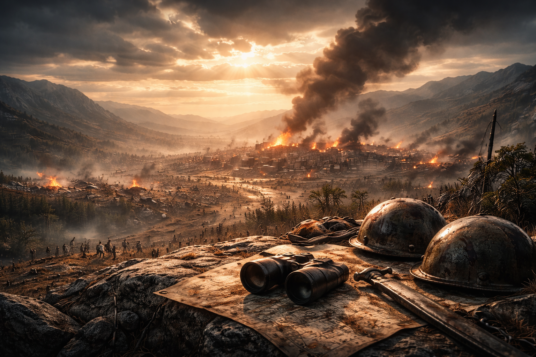
We have already established that force is not inherently immoral. In certain moments, it may be permitted. In some circumstances, it may even become necessary, including war.
If force can be justified in defense, does that mean there is a responsibility to liberate the oppressed beyond our borders? Is there ever a moral duty to use force beyond one’s own borders?
Permission Does Not Automatically Create Duty
Christian moral reasoning has long recognized that defensive force may be justified when protecting the innocent or restraining grave evil. But the mere existence of oppression somewhere in the world does not automatically impose a universal obligation upon any particular nation to intervene. If it did, no nation could ever refrain from war. The world would be a permanent battlefield.
Oppression exists in many forms and places. Political prisoners languish in Iran. Severe repression and systemic control define life in North Korea. Regions of Mexico endure cartel violence and state weakness. The war in Ukraine has produced mass displacement and civilian suffering.
The existence of suffering alone cannot determine military obligation. If it did, intervention would be constant. Christian ethics has always insisted that moral permission to act does not automatically translate into moral necessity. Something more must be present before duty arises.
When Evil Expands
A crucial distinction must be made between evil contained within borders and evil that aggressively crosses them.
When Adolf Hitler began expanding beyond Germany, annexing territories and initiating conquest across Europe, the moral situation shifted. The issue was no longer internal tyranny alone. Aggression had become international. Neighboring nations were invaded. Alliances were triggered. Extermination and domination were no longer confined to one regime’s internal policy but threatened the stability of entire regions.
By the time the United States entered World War II, the conflict was no longer merely a humanitarian rescue. It was bound up with direct aggression, treaty obligations, and the preservation of international order. In such cases, intervention becomes entangled with defense.
This distinction matters. When injustice becomes expansionist and aggressive, the moral category begins to shift from optional rescue to defensive containment. The language of liberation may still be present, but the underlying justification is no longer compassion; it is the protection of life and order against spreading harm.
When Intervention Goes Wrong
The Vietnam War illustrates what happens when the justification blurs.
Communism was undeniably oppressive. The suffering associated with it was real. Yet, the strategic and moral coherence of that particular intervention was widely debated. Was it direct defense? Was it ideological containment? Was it driven by fear of geopolitical credibility collapsing? The answers were contested from the beginning.
The absence of clear, immediate defensive grounding complicated the moral case. Christians were divided not because they dismissed oppression, but because they questioned whether the intervention satisfied the classic criteria of necessity, proportionality, and realistic hope of a just outcome.
Caution in such cases is not cowardice but moral sobriety. A nation can possess military capability without possessing moral warrant. The presence of evil does not eliminate the need for prudence.
Is There a Moral Duty Beyond Borders?
Such a duty may arise when several conditions converge: when aggression is ongoing and clearly expanding; when atrocities are severe and systematic; when non-violent remedies have been exhausted or shown to be futile; when intervention has a reasonable chance of reducing rather than multiplying suffering; when the response is proportionate and limited; and when the goal is protection rather than domination.
Remove these conditions, and “liberation” can quickly become a mask for ambition or self-righteous moral engineering. But if these conditions are met and action is still refused, restraint may become negligence or complicity.
The Responsibility of Church and State
The Church
The church’s authority is moral and spiritual, not coercive. Its responsibility is to speak truthfully about injustice, to advocate for the oppressed, to call rulers to account, and to pray for wisdom and restraint.
The church may urge action when evil expands. It may also warn against rash interventions. What it must not do is baptize national ambition as a divine mandate. When the church uncritically fuses its witness with state power, it loses its prophetic voice.
The State
The state bears responsibility for public order and the restraint of wrongdoing. Its primary mandate is the protection of its citizens and the preservation of stability. It is not charged with saving the world.
Yet when external aggression destabilizes regions, threatens allies, or sets in motion forces that will predictably endanger its own people, the state may have grounds for action. Even then, the justification must be carefully articulated, and limits must be real. The heavier the power, the heavier the moral burden.
Christians Within the State
For Christians who serve in public office, the military, policy advising, or who participate in democratic systems through voting and civic engagement, the matter becomes personal. They are compelled to ask difficult questions: Is this truly defensive? Are we protecting or projecting power? Is the harm restrained? Is the objective limited and just? Will this realistically reduce suffering?
In rare circumstances, conscience may compel support for intervention. In many more, conscience should restrain it.
A Present Tension
Consider the war in Ukraine following the invasion by Russia. The aggression crossed borders. Civilian harm followed. Regional stability was shaken. It is not irrational for Christians to wrestle seriously with the scope of response, precisely because the aggression was external and expansionist.
Contrast this with internal repression in Iran. The suffering is undeniable. Yet full-scale military invasion could ignite wider regional conflict and multiply instability. The moral calculus differs because the nature of the threat differs.
Recognizing those distinctions is responsible moral reasoning.
The Danger on Both Sides
Two temptations persist. One is apathy: to conclude that suffering beyond our borders is none of our concern. The other is hubris: to assume that military power is the primary instrument for correcting injustice wherever it appears.
Christian moral reasoning rejects both extremes. We are not permitted indifference to suffering. But neither are we authorized to treat force as a universal solution.
The Uncomfortable Conclusion
Force may be permitted. It may even be morally required. But the threshold should remain high.
Christians must resist romanticizing war. They must resist absolutizing nonviolence. They must refuse to sanctify national power. And they must avoid retreating into isolationism.
The central question is not simply whether we can act. It is whether we must.