
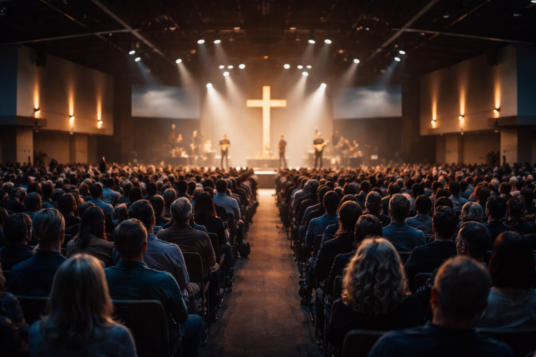
Many church leaders have assumed that if attendance were stronger, the church would be healthier. If buildings were fuller, faith would be deeper. If engagement were higher, discipleship would naturally follow.
But that assumption does not survive honest inspection.
Churches can be full and still worldly. They can grow and still fail. They can reach thousands and yet produce Christians who remain spiritual infants for years.
The real crisis facing the church today is not attendance. It is formation.
Every week, churches track attendance to answer a basic question: how many people showed up? Attendance does indicate something. For some, churchgoing is habitual. For others, it reflects interest or curiosity. At minimum, it shows how many people chose to be present.
What it does not show is spiritual maturity.
A crowded room does not tell you who people are becoming.
Numerical growth is not the same as spiritual growth. Likewise, declining attendance does not automatically signal shallow faith. There is a common claim, sometimes true and sometimes romanticized, that smaller churches tend to be more mature while larger churches are more shallow. Whether or not that holds in any given case, the deeper point stands. Attendance is a poor proxy for formation and should never be treated as its measure.
What many pastors, educators, and church leaders have observed, and quietly lamented, is widespread biblical illiteracy. Large numbers of people attend church regularly yet cannot explain the basic storyline of Scripture, its core doctrines, or its moral demands. In many congregations, even small group leaders lack confidence to lead serious engagement with the Bible, opting instead for lighter and more relational gatherings. In others, preaching avoids sustained exposition and lacks robust teaching environments.
If churches do not meaningfully teach Scripture, it is fair to ask what they expect their people to know and how they expect them to live.
Biblical illiteracy carries predictable consequences. When Scripture does not shape the mind, people default to personal preference, inherited biases, cultural assumptions, and prevailing moral moods. This explains why many Christians live in ways indistinguishable from the broader public. It also explains the confusion both inside and outside the church. If religious faith is real and important, why does it seem to change so little?
A church that does not shape conscience will eventually mirror the culture that does.
The question, then, is not whether people are being formed, but by what. Most Christians are shaped far more by their social environments than by Scripture. Family systems, workplaces, peer groups, media consumption, political narratives, and algorithm-driven platforms all exert daily pressure. Across ordinary life, minds are trained, language is learned, desires are directed, and behaviors are reinforced. Formation is constant.
The church competes in that environment whether it acknowledges it or not.
In practical terms, most churches rely heavily on the weekly worship service as their primary formative moment. Yet many regular attenders are present roughly once every two to three weeks. That means churches often have, on average, one hour every few weeks to shape the inner life of their people. That is profoundly insufficient. Consider how much of a sermon most people can accurately recall even a few hours later.
Yes, many churches offer additional programming such as prayer gatherings, small groups, and service opportunities. For the minority who consistently participate, these environments can foster fellowship and shared practice. Still, even among committed members, deep engagement with Scripture, the development of a coherent biblical worldview, and instruction in spiritual disciplines beyond prayer often remain thin.
Formal teaching through doctrine classes and Bible courses is an improvement and should not be dismissed. Information matters. People need knowledge. But information alone does not produce transformation. It can support formation, but it cannot replace it. Without environments that invite sustained practice, embodied obedience, and communal accountability, programs become religious accessories rather than formative forces.
This lack of intentional formation produces visible outcomes:
- Moral instability
- Political puzzlement
- Fear of being a public witness
- Christians who cannot clearly explain what they believe
- A preference for personal comfort over costly obedience
When an authority neglects its formative responsibility, other forces step in. For example, when parents do not train their children, schools, peers, entertainment, and digital platforms will. If the church does not disciple its people, politics, media, the marketplace, and cultural movements will do so instead.
When the church fails to form its people, other institutions gladly take over.
Healthy formation, by contrast, bears fruit over time in commitment, endurance, moral clarity, and faithful public witness. These are the outcomes churches must learn to recognize and assess. That requires leaders to ask different questions. Not only how many attend, how often they attend, or how many programs exist, but what kind of people are emerging.
Measurement will always be imperfect. Spiritual fruit is personal and often slow to mature. Still, progress can be observed. Are people engaging Scripture consistently? Are they assuming responsibility? Are they growing in service, leadership, restraint, courage, and perseverance?
The central question must change.
Not: Are people coming?
But: Who are they becoming?
Are we forming people who can resist social pressure and its lies?
Can they endure hardship?
Can they live boldly in public without compromise?
Do they practice charity?
Do they maintain a robust devotional life?
Until the church answers those questions honestly, attendance will continue to distract from the deeper crisis in plain sight.